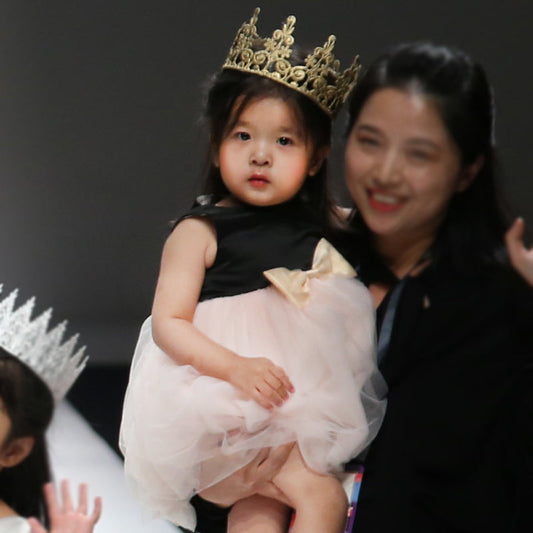
One Dress, Three Interpretations
How thoughtful changes to proportion, length and silhouette helped one Hanakimi gown feel uniquely right for three young girls.
Some dresses are chosen exactly as they are. Others begin to take shape only after a family has chosen them.
At Hanakimi, parents often come to us because they already love the character of a dress: its fabric, its line, and the way it looks in the original photographs. Then comes a thoughtful request:
"This dress is beautiful. I just want it to feel a little more like my daughter."
That request is where customisation begins. It is not simply a matter of choosing the nearest size or adding a few centimetres to the hem. Children of the same age can have very different shoulder lines, torso lengths, frames and proportions. A dress may technically fit and still not feel quite right on the child wearing it.
Our aim is not to ask a child to adapt to the dress. It is to consider how the dress can be adjusted around the child while keeping the original design intact.
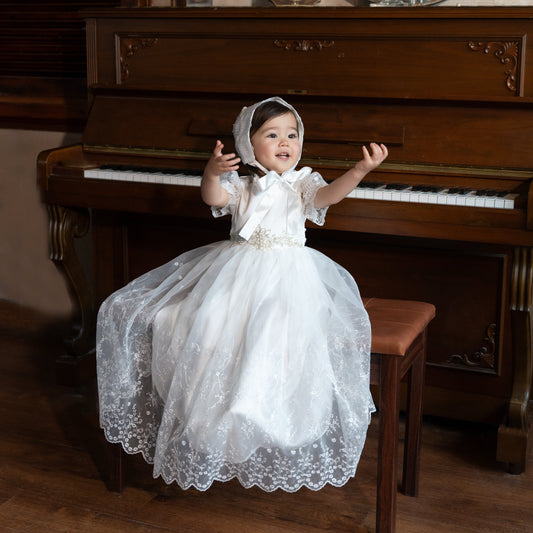
The same Hanakimi gown was recently reworked for three young customers. Each version kept the spirit of the original, but the balance of bodice, skirt and length was reconsidered for the child who would wear it.
Case 01 | 76 cm, 9.6 kg (approx. 30 in, 21 lb)
Making the dress feel lighter
At 76 cm tall, the first child was still at a stage where softness and ease mattered more than visual drama. For very young children, the biggest fitting question is often not a single measurement on paper, but the overall visual weight of the dress.
A bodice that looks slightly too long can pull the proportions down. Too much skirt volume can overwhelm a small frame. Details that feel beautifully balanced on an older child can appear dense when the wearer is still very little.
Our approach was deliberately light. We brought the visual focus upwards, adjusted the bodice proportion for her smaller frame, and softened the way the skirt opened. The dress still had the presence of occasionwear, but it did not feel heavy or overdone.
The result was not simply a smaller copy of the original gown. It was a quieter, softer version with enough room for the child herself to remain at the centre of the look.
Case 02 | 83 cm, 10.5 kg (approx. 33 in, 23 lb)
Why mid-calf was the right length
The second child's mother had a clear preference: she did not want a floor-length gown or a long, formal robe effect. She wanted the hem to fall around mid-calf.
It was a considered choice. When families first shop for occasionwear, it is easy to assume that a longer skirt will always look more formal. In practice, elegance comes from the relationship between the hemline and the child's proportions, not from length alone.
On an 83 cm frame, a lower hem would have shifted the visual weight downwards. At mid-calf, the silhouette felt lighter and more open. The skirt could move naturally as she walked, preserving the energy and ease that belong to childhood.
We reset the length and rebalanced the skirt volume to suit it. The finished dress still felt special, but there was nothing stiff or overly formal about it. In this case, the right decision was not to make the gown longer. It was to make every proportion feel more intentional.
Case 03 | 96 cm, 14 kg (approx. 38 in, 31 lb)
From ankle length to a doll-dress silhouette
The third customisation involved the most substantial change. Her mother loved the original character of the gown, but had two clear requests: the skirt should reach the ankle, and the bodice should be shorter so the finished shape felt closer to a traditional doll dress.
Extending a skirt is rarely an isolated adjustment. If the hem moves down while the bodice stays exactly the same, the overall silhouette can become flat or elongated. That would have worked against the lifted, childlike proportion the family wanted.
We therefore treated this version as a pattern rework rather than a simple length alteration. The bodice was shortened, the visual waist was raised, and the skirt was balanced to fall from a higher point. The ankle-length hem kept the sense of ceremony, while the revised upper proportion gave the dress lightness and shape.
The finished gown was unmistakably Hanakimi, yet it also felt specific to the child. She was not wearing a standard design that had been stretched to a new length. She was wearing a version whose proportions had been reconsidered as a whole.
What do we mean by a doll dress?
In children's occasionwear, 'doll dress' describes a proportion rather than a costume. The bodice is usually shorter, the visual waist sits higher, and the skirt is released from a higher point. The effect is light, rounded and distinctly childlike, with roots in traditional European children's dress.
This silhouette can work especially well for younger children, finer frames, or families who want a more traditional look. It is not more or less formal than a conventional gown. It simply creates a different relationship between the child and the dress.
For the 96 cm customer, that distinction mattered. Her family did not only want a longer skirt. They wanted a silhouette that felt balanced, youthful and right for her.
Customisation goes beyond hem length
Length is often the first detail families ask about, but it is only one part of a successful custom fit. Depending on the style, customisation may also involve the bodice proportion, waist placement, skirt volume, the way the hem opens, or the arrangement of lace and decorative finishes.
These can sound like small changes, yet each one affects the way the complete dress reads. A new hemline may require a different skirt balance. A higher waist may change how the bodice and sleeves sit together. A lighter arrangement of trim can make a design feel more youthful without removing its sense of occasion.
This is why we do not think of customisation as a menu of isolated alterations. We look at the full silhouette and ask whether every element still feels connected.
Why we are sharing these three fittings
We are not sharing these cases to suggest that every design can be changed in every possible way. We are sharing them to help parents see that a good fit is about more than whether the label shows the correct size.
Proportion matters. The child's stage of growth matters. So does the feeling a family wants the dress to have: light and age-appropriate, crisp and mid-calf, or ankle-length with a more traditional doll-dress shape.
Measurements give us the starting point. A clear conversation about the desired silhouette tells us where the dress should go next.
Designed around the child
From sketch and fabric to pattern and final adjustment, a Hanakimi dress is not made simply to reproduce an official photograph. The goal is to preserve the character of the design while finding the proportions that feel right for the child wearing it.
Our approach draws on European occasionwear traditions and contemporary childrenswear construction. It is careful rather than showy, and it recognises that the most memorable dress is not always the most elaborate one. It is the one that looks considered, feels comfortable, and belongs naturally to the moment.
Years later, a family may remember the celebration, the photographs, or the way a child turned in front of the mirror. We hope the dress becomes part of that memory because it felt genuinely made with her in mind.
A child should not have to fit the dress. The dress should be thoughtfully considered around the child.
The Hanakimi approach
Considering a custom Hanakimi dress?
Share your child's current measurements, your preferred length and silhouette, and the date of the occasion. Our team will advise which adjustments are available for the selected design and help you find a proportion that feels both special and age-appropriate.
Customisation note: Customisation is available on selected styles and is subject to atelier review, production lead time and material availability.
Tags:
Previous
HANAKIMI – Ceremonial Childhood Wear for Life’s First Milestones
Next
How to Choose a Children’s Ceremony Dress for Every Special Moment
Related articles
Why Baby Bonnets Are More Than a Hat?
Jul 13 2026
What Is a Christening Gown?
Jul 08 2026

The world about HANAKIMI
Jun 09 2026